
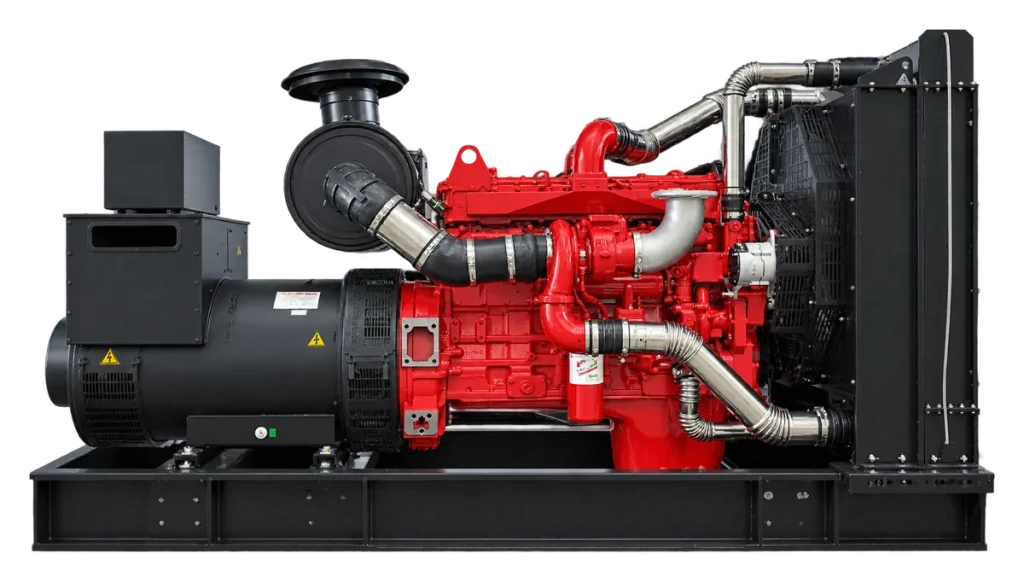
To size a diesel generator, check the running load and the motor-starting condition separately: work out the total load at the moment the largest motor starts in consistent units, then choose a set whose rating and motor-starting capability cover it. Getting this right avoids both an overloaded set that trips and an oversized set that runs lightly loaded, wastes fuel and suffers from wet stacking.
1. List every load
Write down each piece of equipment the generator must power and its rated power in kW. If only amps are known, use kW = √3 × V × A × PF / 1000 for three-phase loads. Mark which loads run at the same time.
2. Allow for motor starting
Induction motors draw three to six times their running current when they start direct-on-line. Check this starting condition separately from the running load: express the running load and the starting demand of the largest motor in the same unit (kVA) to get the total load at the moment it starts, and make sure the generator set’s motor-starting capability covers it. Soft starters and variable-frequency drives lower the starting demand; our engineers confirm the calculation for your loads.
3. Convert to kVA and add a margin
Generator sets are rated in kVA at 0.8 power factor, so kVA = kW / 0.8. Add 20–25% for future loads and to keep the engine working in its efficient range of about 50–80% load.
4. Choose prime or standby rating
Use the prime rating when the set is the main power source and runs for unlimited hours. Use the standby rating only for emergency backup when the grid fails.
5. Check the site conditions
Altitude above 1,000 m and ambient temperatures above 40 °C reduce engine output; tell us your site conditions so we can apply the correct derating.
Send your load list or single-line diagram to our engineers and we will recommend a suitable model from our 10–3750 kVA range free of charge.